
Welcome to VoiceMap’s newsletter, Senses of Direction.
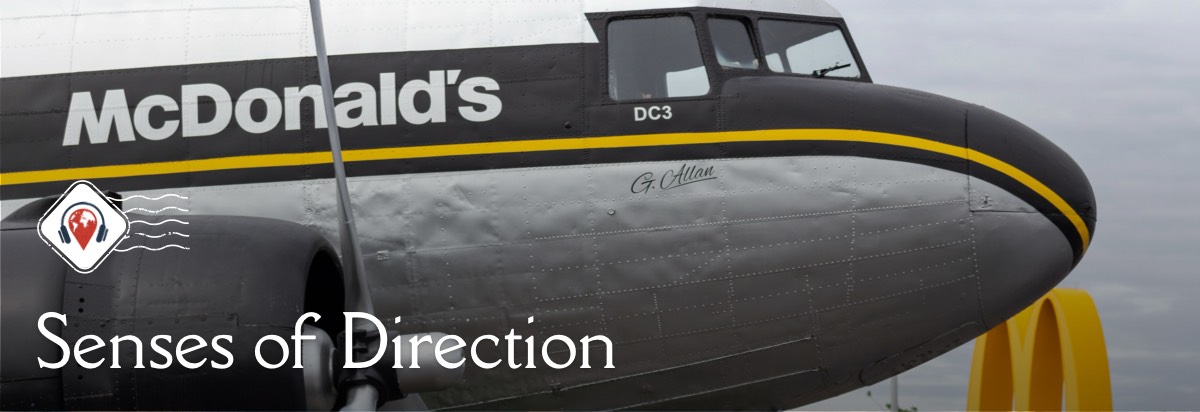
In our eighth edition, we take a sensory journey to the Silk Road, where music remains one of the trade route’s most enduring exports. Cultural exchange through commerce is also the theme of a new book, taking us to the far corners of McDonald’s’ surprisingly eclectic empire, where you’re as likely to find macarons and McSpaghetti as you are a Big Mac.
And from Gloucester, on the site of a McDonald’s that was once a bank, there’s the story of a very real miser who inspired Charles Dickens’ fictional Scrooge.
You can sign up to the Senses of Direction newsletter by entering your details below:
For your sense of melody | A Silk Road Oasis: Life in Ancient Dunhuang
For many of us, the ancient Silk Road calls to mind camel caravans looping their way through the Gobi desert, carrying spices, silk, and other valuable commodities from east to west. But this global trade route – generally considered the world’s oldest – also scattered ideas, religion, culture, and technology across Eurasia, like dandelion seeds in the wind.
Listening to eclectic music that travelled the Silk Road(s) was a highlight of my visit to A Silk Road Oasis – Life in Ancient Dunhuang. This ongoing exhibition at the British Library offers visitors a glimpse of daily life in the northwestern Chinese town of Dunhuang, a vital resting place along the network of trade routes.
Back home I’ve returned to its collection of diverse music, which has happily been uploaded for anyone with an appetite for something fresh to listen to. Expect to be transported by traditional sounds from Dunhuang’s surrounds, like the ‘Zoroastrian Morning Prayer,’ and music by a Uyghur composer and ethnomusicologist who believes “music is the most effective instrument in making cultural exchanges happen.”
The soundscape weaves together archival tracks with contemporary recordings by artists from Iran, Kazakhstan, Xinjiang, Tibet and China – some inspired by the trade hub and its treasures, and others performed on traditional instruments like the dramyin, a Himalayan folk music lute.
Music aside, the exhibition brings together over 50 manuscripts, paintings and artefacts from this cultural melting pot, several of which were discovered in 1900 by a Chinese Daoist priest in the nearby Mogao Buddhist cave temples, and are now on public display for the first time. The International Dunhuang Programme (IDP) has created an extraordinary digital archive where anyone can access celebrated artefacts like the Diamond Sutra – the earliest clearly dated and complete printed book in the world – along with thousands of images from Eastern Silk Roads sites.
🔗 Enjoy this time capsule that “opens up a window into the lives of the people that inhabited or transited through the oasis town of Dunhuang” in the IDP’s short video. To find out why the “seductively Sinocentric concept of the Silk Roads is still problematic,” read William Dalrymple’s review, and for a taste of the exhibition’s captivating music in situ, watch this clip with composer and genre-bending guzhengist Wu Fei’s music. If you have the good fortune of leisure time in London before the British Library’s exhibition closes next Sunday, get tickets here.
For your sense of taste | McAtlas: A global guide to the Golden Arches
Can you imagine embarking on a self-funded quest to document McDonald’s restaurants in over 50 countries? For the James Beard Award-winning photojournalist Gary He, it was an “important journalistic story to tell that no one else was telling in a serious way,” with economic and social effects that are worth our attention. “If we are what we eat, then McDonald’s’ global menu is a portrait of humanity in the 21st century,” he points out.
It all started in 2018 with a Ramadan meal in Marrakesh, Morocco where he began wondering how the multinational localised its menus, and the extent to which its global success depends on it.
Now, after years of on-the-ground research, He has self-published McAtlas: A Global Guide to the Golden Arches, which he calls “a visual social anthropology of the largest restaurant chain in the world.” Inside you’ll find honest, unadulterated photographs of McDonald’s meals around the world, from nasi lemak – a rice, egg, and anchovy dish that’s popular in Malaysia and in Singapore – to France’s McBaguette in France, complete with bearnaise steak sauce. For dessert, there’s locally-made macarons. They’re also sold across Asia, where they give plenty of people their first taste of French confectionery.
He sees the ubiquity of McDonald’s chains as being about “a blending of the global and the local,” rather than cultural homogenization.
“The end result is not just U.S. culture being imposed upon all these different areas around the world. If that was the case, people would only be eating Big Macs and McNuggets. McDonald’s wouldn’t have to localize their menu offerings, which account for roughly 30 percent of their global system-wide sales. That is not insignificant when you consider that total number is something north of $120 billion.”
McDonald’s food has traces of cultural cross-pollination too. “Spaghetti with bolognese sauce became popular in the Philippines postwar as a result of American MREs, or military rations,” says He. “Unfortunately, there was a tomato shortage, and so [Filipinos] created their own version using ketchup made with bananas and food coloring.” When, in the early 1980s, Jolly Spaghetti became a staple at a local competitor called Jollibee, McDonald’s followed with its own version of the sweet marinara spaghetti, and McSpaghetti was born.
“Maybe it’s embarrassing to admit that I spent so much of my own money to document McDonald’s, but it’s the largest restaurant chain in the world with the biggest amount of influence. If they add a menu item, the prices of those ingredients will change. McDonald’s itself can move markets. So somebody’s gotta [cover] it.”
🔗 You’ll find McAtlas on the book’s dedicated site, more of Gary He’s work here, and a behind-the-scenes reel of Colombia’s McCriollo breakfast being photographed here.
For your sense of thrift | Scrooge and Gloucester’s Old Bank
Of the 41,000 plus McDonald’s restaurants in the world, there’s got to be a fair number in historical locations with a story to tell. One is the former Gloucester Old Bank in the centuries-old British city centre, founded by the legendary James ‘Jemmy’ Wood – better known as the Charles Dickens character he inspired: Ebenezer Scrooge.
The notoriously miserly man died in 1836 with a fortune of almost £1.25 million but was so frugal that he rarely replaced his tattered clothes. He was often assumed to be a vagabond or a thief, and was once beaten up for picking turnips on his own property!
🔗 Listen to entertaining tour guide and former journalist Steve Roth bring the story to life here. It’s just one location on Gloucester’s Gifts: How an Ancient City Helped Change the World, his VoiceMap tour about the characters that helped shape the city.
Until next time, thanks for travelling with us!
Best Wishes,
Claire
Looking for a last-minute gift? VoiceMap’s digital gift cards are a thoughtful surprise for friends and family who delight in discovery. Just add a personal message and choose your delivery date.