
Welcome to the tenth edition of Senses of Direction, VoiceMap’s newsletter, where we share travel-inspired stories that spark curiosity and stimulate your senses.
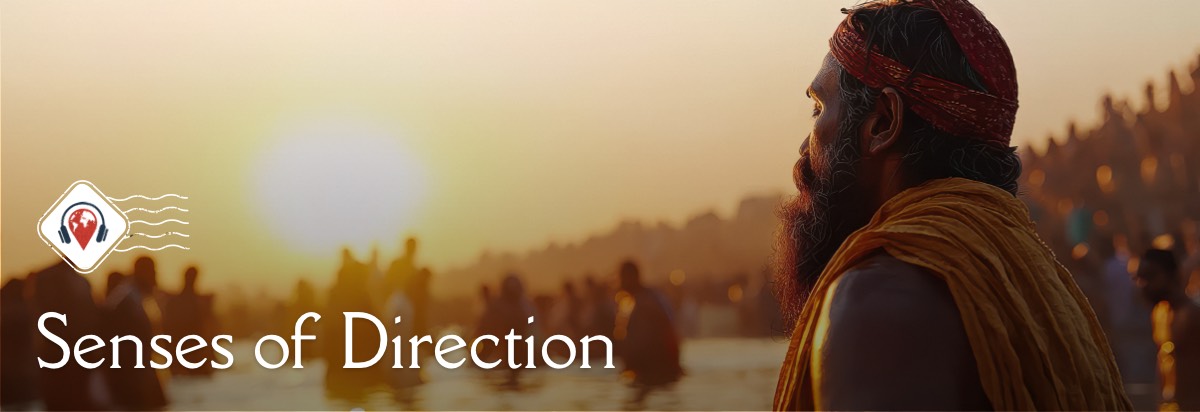
This week we travel to the banks of the Ganges, where a mind-bending 420 million people took part in the Hindu pilgrimage, Maha Kumbh Mela. We also look back at the history of London’s iconic black cabs, at a moment when their days may be numbered, and return to a pub in Cambridge that serves an ale named ‘Eagle’s DNA’ as a tribute to the pivotal scientific breakthrough that was first announced under its roof.
You can sign up to the Senses of Direction newsletter by entering your details below:
For your sense of immensity | Ganga Burn
The largest gathering of humans on Earth took place last month in Prayagraj, in India’s Uttar Pradesh. Kumbh Mela is an important Hindu pilgrimage that takes place every 12 years at the confluence of the “invisible or mythical” Sarasvati river, and – as writer Erik Davis describes it – the “Google-mappable” Ganga and Yamuna rivers.
Davis braved the crowds – and “the palpable presence of actual risk” – to straddle that line between “pilgrimage and tourism,” “participant and observer” during this celebration “at the pulsing mystic heart of one of the planet’s most ancient and god-mad lands.” He was one of around 1.5 million foreign tourists, out of the estimated 420 million people that attended the 45-day-long event.
This year’s Maha Kumbh Mela coincided with a particularly auspicious celestial alignment of Jupiter, the Sun, and the Moon. It only happens every 144 years, and bathing in the sacred waters is believed to help pilgrims achieve moksha, or liberation from the cycle of rebirth.
After days spent amidst “distant bubbling tablas, droning Vedic chants, kirtans veering metalward through distorted PAs and old Bollywood bhajans,” mingling with naked dread-headed sadhus, streetside tattooists, marching bands, and a logistics whiz from Pune, he came away intact, leaving us with an intoxicating account of his experience.
🔗 Give yourself a taste of Davis’ electric prose – accompanied by his fantastical photos from the event – here. Or delve deeper into some of the uglier sides of Kumbh Mela that Davis touches on – including Hindu nationalism, and the tragic stampede that’s been partly blamed on “a culture of VIP entitlement” – here. This video gives you a peek into the festivities, and features interviews with attendees from Bihar to Belgium and Brazil.
For your sense of direction | The London taxi’s final days?
Picture a street anywhere in central London. What can you see? The city’s grey-slabbed pavements, speckled by purposeful pairs of feet, and probably a billboard or two – pasted, perhaps, on a red double-decker bus. You’ll almost certainly see the gleaming black body of a taxi: a ‘black cab’, with a cabbie inside, who’s as much a London institution as the iconic vehicles themselves. But for how much longer?
According to a report released this month by Centre for London, if black cabs’ numbers continue to fall at the current rate, they could all but vanish by 2045. Other figures suggest five years earlier. The test that all black cab drivers must pass – ominously called ‘The Knowledge’ – is just one reason. It requires trainee cabbies to memorise 25,000 streets within a six-mile radius of Charing Cross, and sufficiently covering this ground on a moped or scooter typically takes three or four years.
But, while they’re still around, how many of us know the quirky history behind the black cab, including its links to the Great Exhibition of 1851 and why they are (still mostly) black?
🔗 You’ll find Centre for London’s new report here, and a round-up of the black cab’s biggest threats here. Read the London taxi’s backstory in this article by an American car journalist who drove one for a day, and a colourful account about how difficult it is to pass ‘The Knowledge’ by a London cabbie. This short video explains how cabs (and their horse and cart predecessors) came to be known as Hackney carriages, and this even shorter video gives you the basics.
For your sense of justice | Pints of DNA
When it comes to famous British institutions, the humble pub is right up there beside black cabs – in my mind at least.
Here’s a surprising story that takes place at Cambridge’s second oldest pub, where – “fuelled by the thrill of discovery, and perhaps a pint or two” – a pair of scientists proudly proclaimed that they’d uncovered the ‘secret of life’ on 28 February 1953.
This revelation was shared at the local watering hole for staff and students at the University of Cambridge’s Department of Physics, but not everybody was there to toast a discovery that would change the course of science and medicine forever.
🔗 Listen to the story here, from this brand new VoiceMap, created by the University of Cambridge to coincide with the Cavendish Laboratory’s 150th anniversary.
Until next time, thanks for travelling with us!
Best Wishes,
Claire
Looking for a thoughtful last-minute gift? VoiceMap’s digital gift cards are a thoughtful surprise for friends and family who delight in discovery. Just add a personal message and choose your delivery date.