
Welcome to VoiceMap’s newsletter, Senses of Direction, where we share stories from around the world that spark curiosity and stimulate your senses.
This month, we travel to London’s kaleidoscopic past, back to that critical point in the 90s when “we sensed that we were living our last moments in the material world, before all our visions migrated online.”
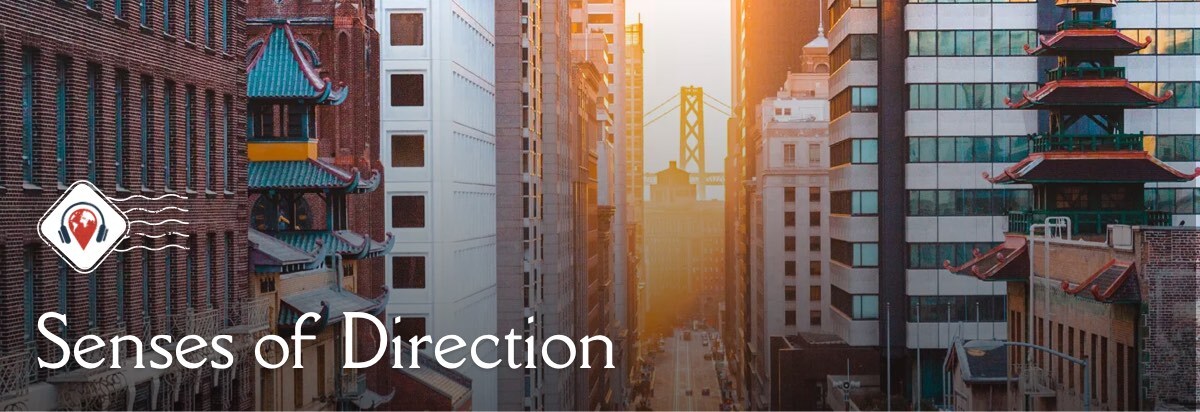
A few days into the Year of the Fire Horse, we venture to Chinatowns across the United States to consider what creates – and challenges – people’s sense of culture and belonging. Lastly, we visit the Golden Gate Fortune Cookie Factory, where this sweet treat has been produced for decades, to find out how Chinese it really is.
You can sign up to the Senses of Direction newsletter by entering your details below:
For your sense of possibility | Excavating the disenchanted city
If you’d asked me to describe London in one word at age 22, when I was fresh off the boat, I almost certainly would have chosen “possibility.”
Since then, I’ve had a similar feeling in several mega-cities. There’s something about composite places like Shanghai, Mumbai, and New York – where people’s lives are stacked one floor above the other – that makes the mundane mysterious. You find yourself wondering about your place in all of it, both in the present and across time.
Novelist Hari Kunzru evokes exactly this in his mind-bendingly broad essay, Another London, published this month in Harper’s Magazine. He quotes a writer called Arthur Machen, who described the city – “literally and metaphysically the greatest subject that the mind of man can conceive” – in the late 1800s.
“You may point out a street, correctly enough, as the abode of washerwomen; but, in that second floor, a man may be studying Chaldee roots, and in the garret over the way a forgotten artist is dying by inches.”
To me, it’s a reflection on how big cities ask us to seesaw between feeling anonymous yet individual, in places that are at once generic and unique. Kunzru dances between ideas, connecting psychogeography to punk, and William Blake to a chance encounter with a man secretly planting succulents along the Thames embankment.
It’s an esoteric and, at times, intellectually dense piece of writing that runs to 7,000 words – but it’s also grounded in an eight-mile walk across London. Kunzru makes his way from the British Museum to Greenwich, hoping to “reenchant reality, or at least [his] corner of it,” eighteen years after departing London for New York. Along the way, he recalls the early nineties, when “psychogeography was in the air.”
“Everyone seemed to be interested in exploring the fabric of the city, trying to excavate its strange atmospheres and hidden meanings. I knew people who were teaching themselves urban climbing, trespassing into abandoned buildings as a form of artistic action. (…) My friends and I cycled along canal towpaths and danced at warehouse raves that were advertised on pirate radio stations whose transmitters were concealed on the rooftops of council tower blocks. There was a sense that a change was coming to London. We told ourselves it was the impending millennium, the new thousand-year cycle that the government was celebrating by building a giant dome on the Greenwich Peninsula. In retrospect, I think we sensed that we were living our last moments in the material world, before all our visions migrated online.”
Ultimately, Kunzru’s literary exploration asks us this poignant question: in an age when every street corner is digitally mapped and layered with data, is it still possible to experience the mystery of a place and its many past lives?
🔗 Indulge in Kunzru’s hearty long-form essay, or dip in and enjoy a few bite-sized sections of Another London.
For your sense of culture | Welcome to America’s Chinatowns
The arrival of Chinese New Year last week – and with it, the Year of the Fire Horse – got me thinking about Chinatowns around the world, and how they came to be.
That led me to Welcome to America’s Chinatowns, a fascinating multimedia storytelling collaboration between Google Arts & Culture and the Washington DC-based National Trust for Historic Preservation. It brings together oral histories, archival photos, video, street photography, and 3D reconstructions of lost neighbourhoods, all in one place.
If you’ve ever wondered what San Francisco’s Chinatown (North America’s oldest) looked like in the 1920s, this “time capsule” of interiors – seen through the lens of the May’s Photo Studio – is a great place to start.
There’s also a multimedia section featuring Lauren Yee, the playwright behind King of the Yees. It’s a semi-autobiographical play that deals with intergenerational challenges, like finding a sense of belonging in a Chinese community when you never grew up learning the language.
You’ll also find videos featuring Grace Young. The cookbook author, activist, and food historian talks about how memory and family ties are vital forces in her cooking. She also tells the story of how she became the “accidental voice for Chinatowns” when, on the eve of lockdowns around the world, she began filming a documentary series called Coronavirus: Chinatown Stories. Chinatowns don’t just tell the Chinese American story, she argues – but the story of America itself.
🔗 Whether or not Chinese astrology is your thing, it’s a good time of year to get lost in the rich archive of stories inside Welcome to America’s Chinatowns.
For your sense of tradition | Origins of the fortune cookie
Fortune cookies have become synonymous with China and Chinatowns. But it was more likely Japanese immigrants who created them, as far back as the late 1800s in California. In his VoiceMap tour of San Francisco’s Chinatown, David Hu shares the story behind the family-owned business that’s been producing handmade fortune cookies since 1962.
In some ways, the story of the fortune cookie – invented by one group of newcomers, then popularized by another – is a classic example of how the United States steadily became the melting pot that it is today. At the Golden Gate Fortune Cookie Factory, you can even choose between green tea flavoured or chocolate-dipped versions of the sweet treat that’s become a staple of Chinese restaurants around the world – outside China, that is.
🔗 Listen to the history of the Golden Gate Fortune Cookie Factory, and browse David’s VoiceMap about the country’s oldest Chinese community, San Francisco’s Chinatown: A Food, Culture, and History Walk.
Until next time, thanks for travelling with us!
Best Wishes,
Claire van den Heever
Looking for a last-minute gift? VoiceMap’s digital gift cards are a thoughtful surprise for friends and family who delight in discovery. Just add a personal message and choose your delivery date.