
When I started VoiceMap over a decade ago, I ran a Twitter poll asking what people thought of when they heard the phrase “audio tour.”
Twitter is now X and its archives don’t go back far enough for me to see what all the options were, but I do remember that the overwhelming response was “a dusty museum.” In other words, “audio tour” brought to mind push-button devices with battered headphones and a voice that sounded like a newsreader reciting from an encyclopaedia.
VoiceMap was built to offer the opposite, with great tech that gets out of the way and shows you the world through the eyes of another human. In the age of AI, that founding principle has taken on new significance.
At our January webinar, we asked an existential question. What makes human-created tours irreplaceable when AI can generate content in seconds? The answer is plenty – and it’s backed up by neuroscience, spatial awareness, and the inimitable weirdness of human experience.
Below are some key insights from the session, along with practical guidance on where AI can help – and where human creativity becomes our greatest competitive advantage. There’s also a video recording of the entire webinar just below.
Watch the full webinar
Why “weirdly human” matters for audio tour creators
AI easily passes the Turing Test. It sounds weirdly human – uncanny, and almost, but-not-quite human.
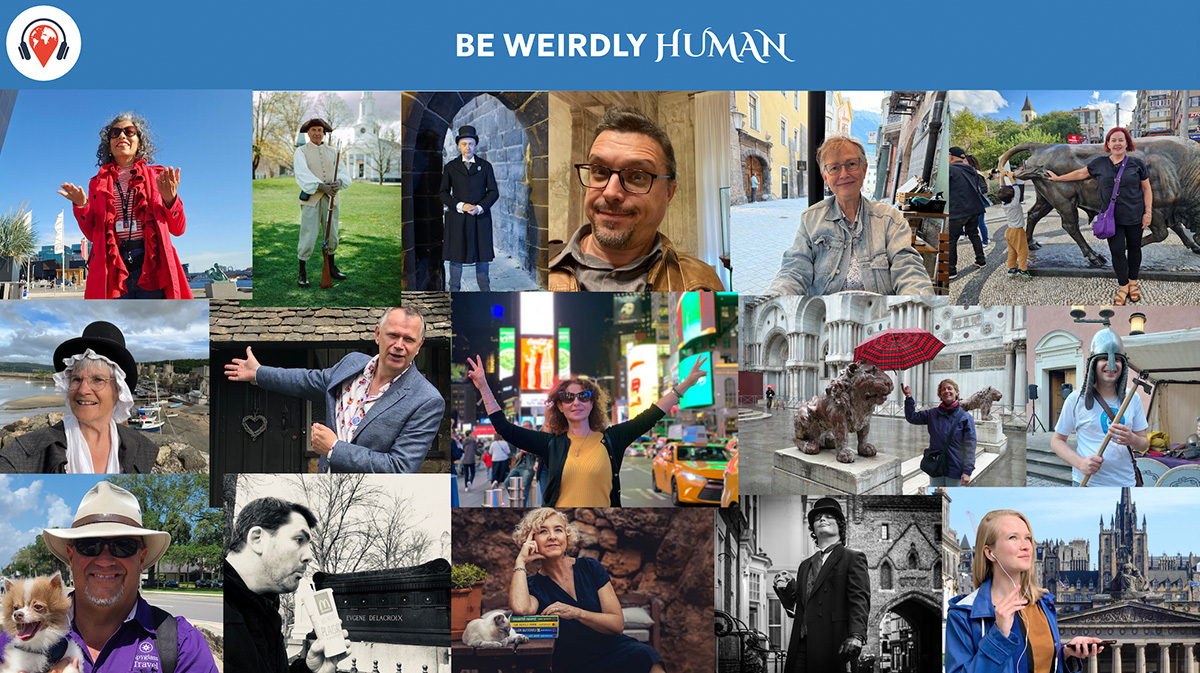
But the future of storytelling belongs to artists willing to be weirdly human – to those of us who lean into our quirks, tangents and strange fascinations in ways that allow for authenticity and new, surprising connections.
This matters for VoiceMap publishers – the storytellers behind our more than 2,000 tours – and for anyone doing creative work in a world where polished, competent content can be generated in seconds.
Two albums, one lesson
In November 2025, two albums made it onto the streaming charts simultaneously.
Breaking Rust was AI-generated country music. Rosalía’s LUX was the opposite: a classically trained Flamenco artist, Rosalia learnt 13 languages over the course of three years, recorded the album with the London Symphony Orchestra, and didn’t use a single loop. In interviews, she said she’s responsible for “97%” of a very personal album that’s ultimately about a broken-off engagement with her ex-fiancé.
Critics called Breaking Rust “laughably generic” and country radio refused to play it. LUX won five stars from Rolling Stone and debuted at number one across four different genre charts.
One reviewer captured it well: “In this AI-everything era, [LUX] is a reminder that creativity comes from lived experience, human tension, breath, and body… The album’s superpower is deeply, proudly, and unmistakably human…”
This pattern will repeat across creative industries. Technical competence is now cheap. Humanity is rare.
Where this conviction comes from
Before VoiceMap, I worked briefly as a journalist at the Daily Telegraph on the travel desk. I quickly realised that travel news was a terrible way to actually see the world. So I ran a pub in the English countryside for a year, saved up, and then travelled from London to Shanghai by land – starting one of the first travel blogs with my partner Claire along the way.
We found an audience by doing the opposite of what was becoming the norm: instead of best-of lists and short-form content designed to rank on Google, we wrote long-form reportage.
We were at our best when we met locals who took us under their wings, to show us how they felt about their corner of the world, because this became a lens for our own experience.
When you talk to someone who has strong feelings about a place, you can borrow their ownership of it. They say things like “I remember”, “I love” or “I hope”, and these phrases transform information into connection. Their passions became my own, just by them pointing at something and telling me a story.
I also found that the major attractions often felt flat. What I remember most vividly isn’t the famous sites but the homes in Ulaanbaatar, Damascus, Gujarat, and rural Shanxi where we were invited to join a meal. That’s the principle VoiceMap was built on, and it’s precisely what AI can’t replicate.
The science of personal storytelling
Self-guided audio tours are a medium that already has powerful building blocks. When you’re physically present in a place while hearing a human voice, two things happen that neuroscientists have studied extensively.
First, your brain anchors the information to the physical space. Studies show we recall information significantly better when we learn it in the environment where we’ll use it. This is context-dependent memory at work. Being there matters.
Second, audio triggers stronger reactions in your brain and body than video. A UCL study found that while people rate video as more engaging, their bodies tell a different story. Heart rate, skin conductance, and body temperature were all higher when listening to audio. Audio demands active imagination. When someone listens to an audio tour, they are, in a sense, co-creating the experience.
But when you add a personal perspective – when a storyteller shares their own memories, opinions and connections to a place – you build on top of this foundation to create something that can truly change how somebody sees the world.
Uri Hasson at Princeton put both storytellers and listeners in MRI scanners. During a personal narrative, the listener’s brain activity actually coupled with the speaker’s brain. The same regions in both brains fired in sync, a phenomenon Hasson calls “a single act performed by two brains.” This didn’t happen when Hasson used neutral, encyclopaedic content for the same tests.
Paul Zak’s research found that personal narratives with emotional arcs trigger oxytocin, the trust hormone. Flat content, even with identical information, produces none. When oxytocin rises, people become 261% more generous.
Then there’s the Pratfall Effect: competent people who show imperfection become more likeable, not less, because vulnerability builds trust. This is why Domino’s could run a campaign admitting their pizza wasn’t great and somehow see a 14% sales increase as a result.
What AI can and can’t do
Let’s be clear about what AI does well. It’s getting more polished and fluent by the month. Its speed is superhuman, and it synthesises research in minutes that would take a human weeks. Its multilingual capacity now outstrips dedicated translation tools. And the cost keeps falling.
If you’re only optimising for what AI excels at, you’re in a race to the bottom.
What AI can’t do is exist in the world. It has no spatial awareness, no understanding of what it feels like to get lost or to turn a corner and see something unexpected. I’ve seen pure AI tour generators produce content that sounds fine but takes you to places in sequences that make no sense, with long empty stretches, and no sense of whether the payoff at the end of a steep 1 kilometer climb is worthwhile.
More fundamentally, art requires an accumulation of choices. Science fiction writer Ted Chiang put it well: a 10,000-word short story involves something like 10,000 choices. When you prompt AI, you make very few choices and the input is always smaller than the output. That’s pretty much the point of AI.
A recent UC Berkeley study confirms this. When researchers had multiple people prompt AI independently, the outputs converged toward sameness. The mere filter of AI reduced everything to a narrow band of similarity. That means that if you sit down and do the work yourself, you arrive at a wider range of conclusions than AI ever would.
Where AI can help: practical tips for audio tour creators
I’ll summarise the webinar’s tips for using AI to help with the process of publishing a VoiceMap audio tour below, but in the Q&A after the webinar it was clear that we could offer more here. We’re planning to publish deep dives into specific aspects of the publishing process.
Mapping
AI isn’t spatially aware, so don’t ask it to structure your route. But it’s excellent as a research assistant – finding quotes, historical details, obscure stories that go beyond Wikipedia. Use it to fill contextual gaps, not to replace walking the ground yourself.
Scripting
If you’re not a natural writer, AI can be a useful partner. Set up a project with your route outline, research and VoiceMap’s guidelines. Give clear instructions:
- This will be spoken, not read
- You want authenticity and intimacy
- The tour should feel larger than the sum of its parts
Ask AI to identify repetition and suggest ways to build on earlier points. Then – and this is essential – get the output out of AI and make it your own. Work through it line by line.
Recording
There’s no substitute for a real human voice. Not a professional voice – just a person. Imperfection humanises. That said, if your accent genuinely interferes with comprehension, tools like ElevenLabs and Fish.audio can train on your voice and produce something that sounds like you but is easier to understand. For additional voices – for historical quotes or characters – AI is genuinely useful.
Publisher profiles that stand out in search results for self-guided tours
Google added “Experience” to its E-E-A-T framework in 2022, specifically because AI was flooding the web with expert-sounding content that had no one behind it. The question Google now asks is: has this person actually been there? Do they have a genuine relationship with this subject?
We’ve just released a major update to publisher profiles to address exactly this. The new profiles include overall ratings and tour counts, a tagline that sells you, not just your services, flexible location fields, expanded link options – including Wikipedia, Patreon, and Substack – as well as space for a bio with real substance.
These updates help distinguish your tours from AI-generated slop, which give you a bump in Google search results as well as responses to AI queries using tools like Claude and ChatGPT.
Your bio matters more than you might think. If it’s under 150 words, there’s a good chance Google won’t even index your profile page. We’ve also added structured credentials: awards, publications, education, certifications, professional associations and achievements.
Full documentation on updating your profile is available in our publisher documentation. Take the time to do it properly.
Be weirdly human
The idea of authority is changing. In a world where expertise can be easily generated, authority increasingly comes from lived experience.
Rosalía put it simply: “The more dopamine, the more I want the opposite.”
Most of us feel that way. We’re surrounded by content optimised for engagement metrics, designed to capture attention rather than reward it. VoiceMap audio tours offer something different: periods of time when you’re immersed in your surroundings, paying attention in a way you don’t in everyday life.
Your memories, opinions and weird fascinations aren’t unprofessional indulgences to edit out. They’re the whole point. They’re what triggers neural coupling, oxytocin, and trust. They’re what AI can’t replicate.
Be weirdly human. The science says it works.


