
Welcome to VoiceMap’s newsletter, Senses of Direction, where we share stories from around the world that spark curiosity and stimulate your senses.
This month, we follow a journalist down Alaska’s coast as he rummages through “the tide pools of memory.” We hear a heat expert’s thoughts on how hotter summers might just make us better travellers – if we learn to adapt.
Finally, on the day of the FIFA World Cup final, we discover the near sanctity of icons like FC Barcelona and Maradona, then go behind the scenes of the TV shows that have helped popularise football in the US.
For your sense of what remains | WHAT WASHES UP ON A WILD ALASKA COAST?
Since we shared Paul Salopek’s dispatch about his journey from Japan to North America by container ship, the journalist has been making his way along Alaska’s “beautiful, largely uninhabited, and storm-walloped” Outer Coast.
In this thoughtful new article, What Washes Up on a Wild Alaska Coast? he describes a 650-kilometre trek with 28-year-old ‘wilderness connoisseur’ Rowan Sharman – “thin as a pin and tougher than a two-penny nail.”
It’s full of fascinating details about the flotsam (“objects lost accidentally at sea, and still subject to legal claim”) and jetsam (“junk cast overboard, up for grabs”) that washes ashore by the tonne every year. There’s everything from “unopened cases of medicine from China, the pills long dissolved by seawater” to barges the length of 20-story buildings, to glass fishnet floats that drift over from Japan, “likely hand-blown from melted sake bottles sometime early in the 20th century.”
Sharman grew up collecting these eye-catching glass balls. When he finds one the size of a baseball – “translucent, gleaming, mysterious” – he offers it to Salopek, who declines. Sharman is noticeably disappointed. Salopek explains:
“I have been walking across the world for years. My house is typically a small canvas rucksack. It has no windowsills. It has finite shelf space… Where could I possibly store such gathered treasures? In fact, while pacing off more than 27,000 kilometers of trail, largely through populated rural spaces, I’ve learned exactly the opposite lesson: to simplify, to economize, to shun souvenirs, to shed material cargo for collected ideas.”
There are two types of beachcombing, he muses – inward and outward. As he and Sharman near the only village on the Outer Coast, they find their feet crunching over thousands of dried up Dungeness crab exoskeletons. Salopek only notices how much he’s sped up when Sharman calls out to him.
“The scattering of handlike claws somehow conjures the hands of my people. A woman sitting in a park, slowly withdrawing her hands from between mine… My father’s hands, long gone, spattered with canvas paint. (…) I’m just beachcombing out of my sixth decade of life. There are horizons to go before reaching faraway Tierra del Fuego. I guess I’m in a hurry.”
🔗 Read What Washes Up on a Wild Alaska Coast? on the Out of Eden Walk website, where you can also listen to earlier dispatches and find out more about Salopek’s journey. Here’s the edition of Senses that featured Blue Highway, his description of the crossing from Japan by container ship. You can also explore a detailed map of his route, categorised by transport types.
For your sense of adaptation | HOW ARE SUMMER HEATWAVES CHANGING TRAVEL?
Europe is the world’s most visited continent. It’s also the fastest-warming one, where four of its hottest summers on record occurred in the past five years.
In Summer heatwaves are changing travel, Duncan Craig shows us how the continent’s tourism industry is responding to headline-grabbing heatwaves. The truth is, travel to Europe isn’t slowing down. Despite rising interest in taking “coolcations” to milder climes, France, Spain, Italy and Greece are still consistently among the world’s top 10 destinations.
Part of the problem is the absence of a ‘culture of heat’ among visitors, says Tehran-born heat expert, Dr Mehri Khosravi. “The perception is still that heat is a desirable thing.”
But there’s a reason the Spanish eat so late, and that rush hour in every public square’s playground is after 10pm in the warmer months.
“Sevillanos are used to elaborate heat mitigation measures. These include rainwater-fed water-misting systems in high footfall areas; a network of underground, aqueduct-style chambers that can lower ambient temperatures at street level by up to 9C; street-spanning awnings; and ‘urban cool islands’ – sanctuaries of dense vegetation that are deployed here and in Los Angeles, Singapore, Paris and dozens of other cities.”
I came across some of these simple but effective strategies during one August in Seville, where the winds that blow up from North Africa have nicknamed the region the ‘Iberian oven.’
I also noticed what Craig calls “noctourism”: a new term for the commonsense idea of letting the day cool before setting off on long explorations of a city and its sights. Seville’s Royal Alcázar has shifted to evening opening hours, for instance; Athens’ Acropolis and Rome’s Colosseum have done the same in recent summers. It’s new approaches to heat that will keep us travelling safely, not worrying about heatstroke.
🔗 Find out why hotter weather could have upsides for tourism, and how “climate pressure may act as a catalyst for a more thoughtful, intentional era of travel” in National Geographic’s Summer heatwaves are changing travel.
For your sense of team spirit | FOOTBALL’S ICONS AROUND THE WORLD
The FIFA World Cup final between Spain and Argentina takes place today in New Jersey, USA. But football – or ‘soccer,’ as North Americans call it – is only the country’s fourth most popular sport after American football, basketball, and baseball.
TV shows like Ted Lasso and the Welcome to Wrexham documentary have played a big role in popularising the sport. In Deborah James’ VoiceMap, The Ted Lasso Way: A Richmond Walking Tour, you can hear the story of how writer Brett Goldstein ended up being cast as Roy Kent – despite not being a football player.
Where Now Audio’s tour of Wrexham ends at one of the key filming locations in Welcome to Wrexham: the Turf, the now famous hotel and pub. At another pub, The Long Pull, you can hear the amusing story of how Sky TV paid for locals’ drinks all day and filmed the resulting melee – years before Ryan Reynolds and Rob McElhenney’s documentary raised the Welsh town’s profile.
Both Spain and Argentina – who are facing off today in the World Cup final – have, shall we say, a “passionate” football culture. Find out how on earth a stained glass window with the football club FC Barcelona’s logo ended up adorning a medieval church on John Hipper’s VoiceMap of Barcelona’s El Born and Ciutadella Park.
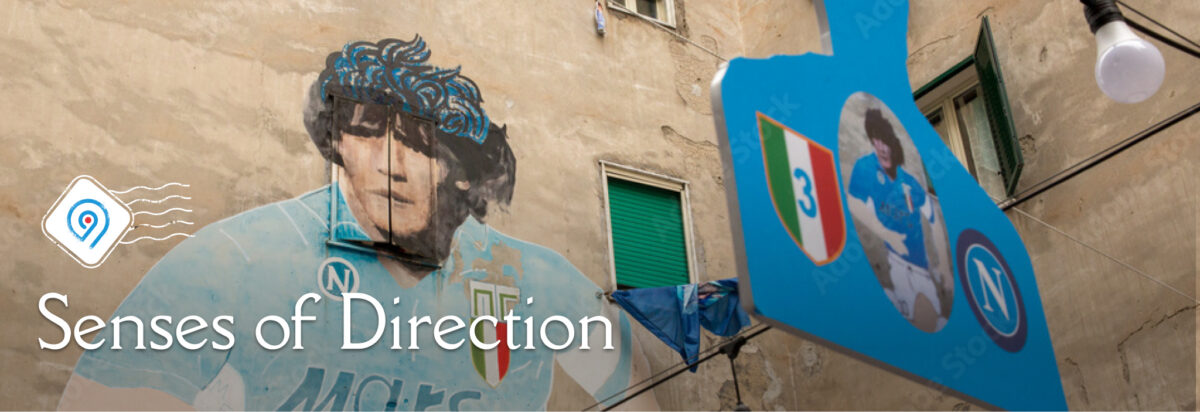
Mike Corradi’s tour of Naples shows us how a city square, Largo Maradona, mirrors the tumultuous life of Argentinian football star, Diego Maradona. The “broken player” arrived in Naples in 1984 and transformed its football club – and, in turn, the city’s identity. After his second title in 1990, fans painted the mural that still dominates this once contested drug-dealing turf, now a monument to Maradona, whose own struggles with drugs have since been forgiven.
🔗 Browse the whole tour, Blood and Passion in Naples: A Guide to the City’s Fiery Heart, and listen to the fascinating story behind the Maradona mural.
Until next time, thanks for travelling with us!
Best Wishes,
Claire van den Heever
Looking for a last-minute gift? VoiceMap’s digital gift cards are a thoughtful surprise for friends and family who delight in discovery. Just add a personal message and choose your delivery date.
