
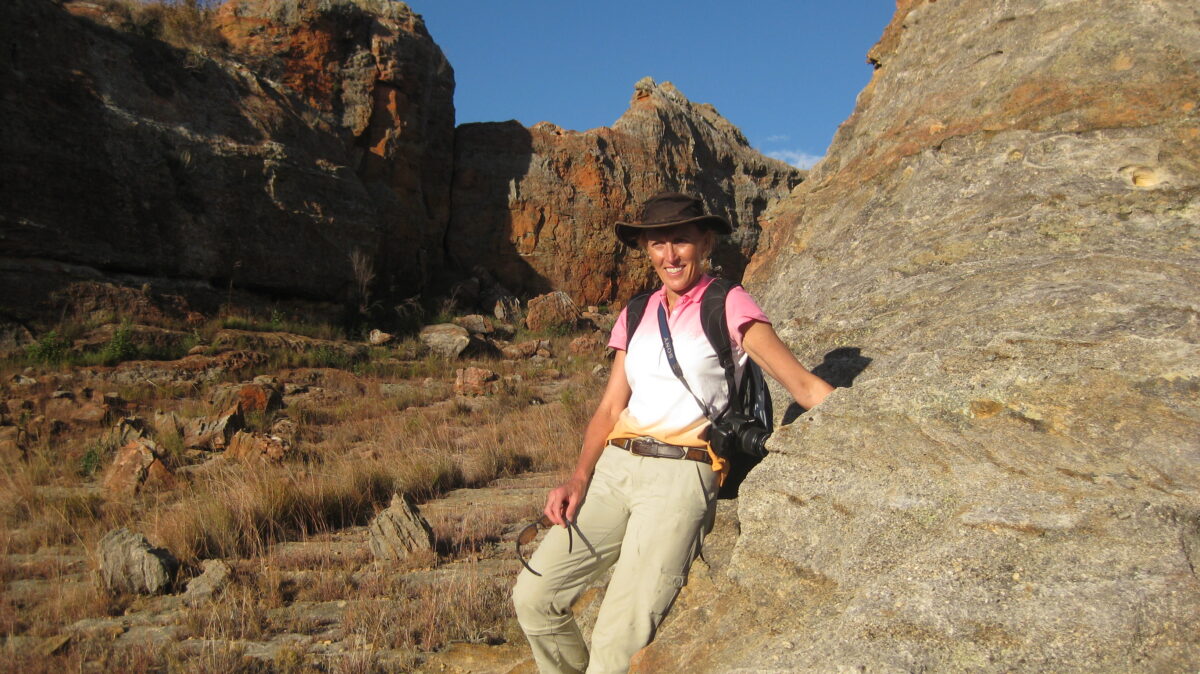
Georgie has spent decades travelling well off the beaten track, from China in 1988 to Uganda in 1991, and family holidays in places like Mongolia and Madagascar.
The day after we spoke, she and her partner James set off on the first one-month chapter of a planned walk the length of India, sleeping in a rented RV `that “had a tendency to leak when it rained.”
She’s taken about 30 VoiceMap tours in 13 countries around the world.
This interview is part of our new How We Travel series, in which we speak to VoiceMap’s community of curious explorers about how they travel.
What do you always pack that other people find strange?
I always travel with some hearty granola snacks in my bag – whether to substitute the soggy pastries on a flight, or stave off my hunger in time of need. They are an essential! My silly travel treat is my winter welly socks for cold flights to keep my feet warm.
What were some of your earliest travels like?
A few years after finishing university, I decided to go travelling with a girlfriend. We bought one of those round-the-world tickets, and did all sorts of things. When we got to New Zealand, the first bus was so expensive, I thought, “I can’t afford this.” So we hitchhiked everywhere, back in the days when you could. One time we got a hitch and the guy said, “Oh, I’m really sleepy. Can you just drive the car?” So we did. We were towing a boat!
Tell us about one of your most memorable trips.
Uganda in 1991 was quite an intriguing place to go as we had read about the “Mountains of the Moon.” James and I did a trip into Queen Elizabeth National Park, and we learned that you don’t put your tent over the tracks where the hippos go to graze at night. We were cowering in our rather low-slung tent with hippos munching around us, and I’ve never been so terrified!
Then we climbed the Rwenzori mountains – on the border between Uganda and Zaire – which was very memorable because Zaire was not in a good way. On the radio, you’d hear all the expats being told to get out of the country: “Leave your dogs behind. Take one suitcase. You’ve got to leave now.”
The climb takes about a week and it was pretty rough. We were up in the snow line, and we didn’t really have the right kit. We stayed in these refuge huts where most of the floorboards had been used as firewood. The guide took a goat, but by day three, the goat looked a bit green, and we decided we couldn’t eat that anymore. The last two days we were on dry Weetabix and cold baked beans… It was probably the toughest trip we’ve done together.
Do you ever return to the same places?
We have returned many times to the southern coast of Sri Lanka for New Year. My three grown-up kids all have this amazing bond with Sri Lankan days as kids, playing in the sea and the garden.
Once, when the war was still going on, we were driving back to Colombo with my parents when suddenly the driver took a right-angle turn into the countryside. James and I could see plumes of smoke further up the coast. There had been a bombing. None of the kids were old enough to realise what was going on, and Mum and Dad didn’t notice. It was only much later that they found out what happened.
How do you get to know a new place?
I love maps, and I’d rather look at a physical map than Google Maps, to be honest. I always say that if you get somewhere high in a place, like up a church tower or city gate, you can get a bit of context and perspective.
Has a trip ever changed how you see things?
Yes. When I went to China in 1988, I saw for myself how the Cultural Revolution hadn’t finished that long ago; many people were still in Mao suits. You had to sleep in the train station to get a ticket, because they only issued six tickets to foreigners a day. In the morning, the police came to hit everyone with batons because you weren’t meant to sleep in the station. They never hit us, though.
We had a phrasebook, and even then we weren’t really getting it right. But it was people’s ways of communicating – the smiling, the waving, the laughing – that I’ll always remember.
How much do you plan in advance when you travel?
I like to have a certain amount of planning done, especially where I’m going to spend the first night. I don’t want to rock up in an airport and think, “I don’t even know where I’m going to sleep!” But I don’t like having everything booked.
I also like to read something ahead of time – even if it’s a novel – to get a taste of where I’m going.
Why do you travel?
If I look out and see a mountain, I’m curious about what’s on the other side. At school, our headmistress used to give us a one-hour lecture each week called “Current Events.” She had a long stick like a snooker cue and would point at a big map of the world, and tell us what was going on. I will never forget those lectures. I think they triggered my curiosity.
I once heard someone say, “Always travel with kindness and curiosity,” and it’s a wonderful encapsulation of why I want to travel.
What do you like about taking VoiceMap tours when you travel?
I love using VoiceMap. It gives me the nuance of a place. My real highlights would be Annie Sargent’s tours in Paris, and Alec Ash’s tour of the old hutongs in Beijing, with his little bars that he loved. I just felt he was there, walking beside me.
We do VoiceMap a lot and I think you should always learn to explore your own backyard. Be a tourist in your own town or wherever you live. With VoiceMap, I always learn something new. It’s like travel. It might not be your bucket-list topic that you want to hear about, but you always come away having learned something.
That is travel, really – whether it’s in a lecture, or you’re physically travelling, whether it’s in your own backyard or the other side of the world. Getting under the skin of a place is what I like to do.
