

Peak season is the moment when everything you’ve put into your tour pays off. In our April webinar, we shared an important finding: tours that earned $50 or more within their first 90 days generated eight times more annual revenue than those that didn’t. This difference in tour tales is most visible between May and October, when audio tour sales are at their highest. The work publishers do leading up to peak season – whether your tour went live last month or several years ago – has a direct impact on how it performs when it counts most.
Below you’ll find the highlights and insights from the webinar, along with the full session recording.
What the numbers say about early momentum
The chart below shows the impact of early momentum on VoiceMap tours published in 2023. Tours that reached $50 in their first 90 days earned a median of $112 compared to $8 for grounded tours (those that didn’t reach that threshold). By the end of the 2024 financial year, that gap had grown to $1,212 versus $122, and over a tour’s lifetime the gap is $3,187 in median revenue for ‘takeoff tours’ against $339 for grounded ones. Early momentum doesn’t just give a tour a head start, it sets the trajectory for everything that follows.
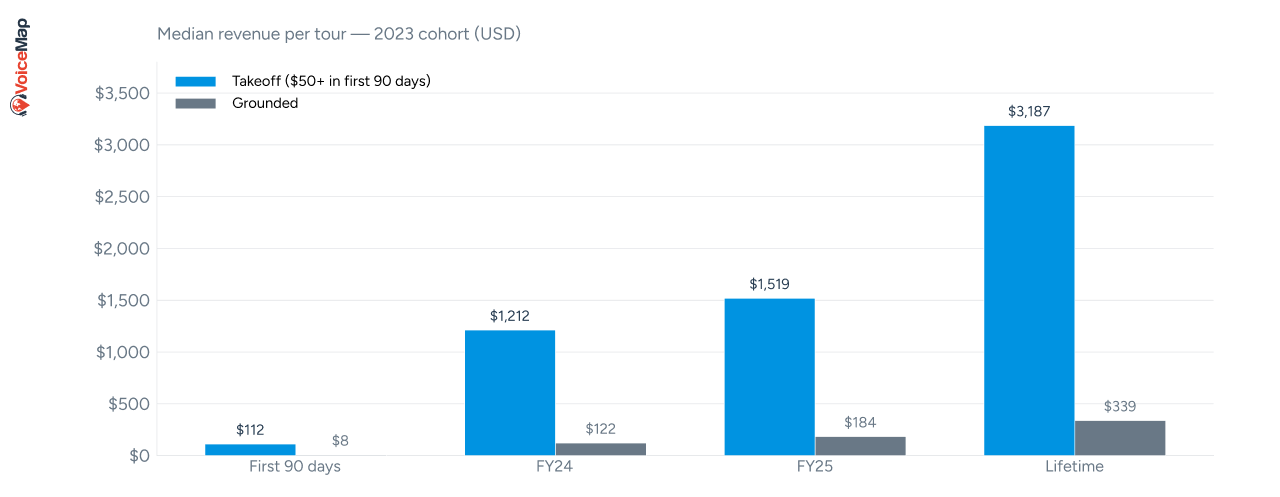
Compounding is the reason. Early earnings generate ratings and reviews, which drive visibility, which drives more sales. A tour that doesn’t reach that $50 threshold in the first 90 days often stalls before the cycle can start. We provide distribution and promotional tools for publishers and amplify the momentum you bring, which is why those first 90 days matter more than they might seem. We’re launching a takeoff programme in the coming months to help new tours build early momentum. There’s a lot you can do for your existing tours, and here’s where to start.
How to maintain momentum going into peak season
The steps that follow are worth working through whatever stage your tour is at. For a newly published tour, they’re the foundations that give you the best chance of hitting that early momentum. For an established tour heading into peak season, they’re the maintenance that keeps the compounding cycle going. The goal in both cases is the same: a tour that a listener enjoys, trusts, and wants to tell someone else about.
If you’re not sure where to start, walk your route and make the updates that will have the biggest impact first. It’s also worth looking across your catalogue with fresh eyes. Tours that haven’t been updated in a while, or ones that don’t perform as well as your others, are often where a bit of attention goes the furthest.
1. Walk your route
The most important thing you can do is walk your tour. Routes change: construction, new roads, and temporary closures can make sections difficult or impossible to complete, and a listener who can’t finish a tour won’t leave a positive review. If walking it yourself isn’t feasible, your ten free tour credits can be converted into voucher codes to send to someone who can. Read more about how that works here.
Testing the route is built into the tour creation process for good reason. We encourage every publisher to walk it a couple of times before publishing. But a six-month check-in is a good cadence to make sure what you published is still what listeners experience on the ground.
2. Review your photos
The two most important photos to review are your tour cover image and the starting location. Your cover image is the first thing a potential listener sees, so make sure you have a high-resolution image that invites listeners to imagine themselves on the tour. The starting location photo helps listeners orient themselves before they begin.
If you’re updating either of these, send it to your editor clearly labelled with the tour name and location name. You can’t add photos to a published tour yourself for now, so your editor is the person to contact for any image updates. Only update images where it’s genuinely necessary. You can find our guide to image sizes here.
The featured location is the stop that listeners can hear before they buy, so make sure you’ve added compelling images to this location. You can update the images for your featured location directly through your tour’s distribution tab. (More on that in the distribution section below.)
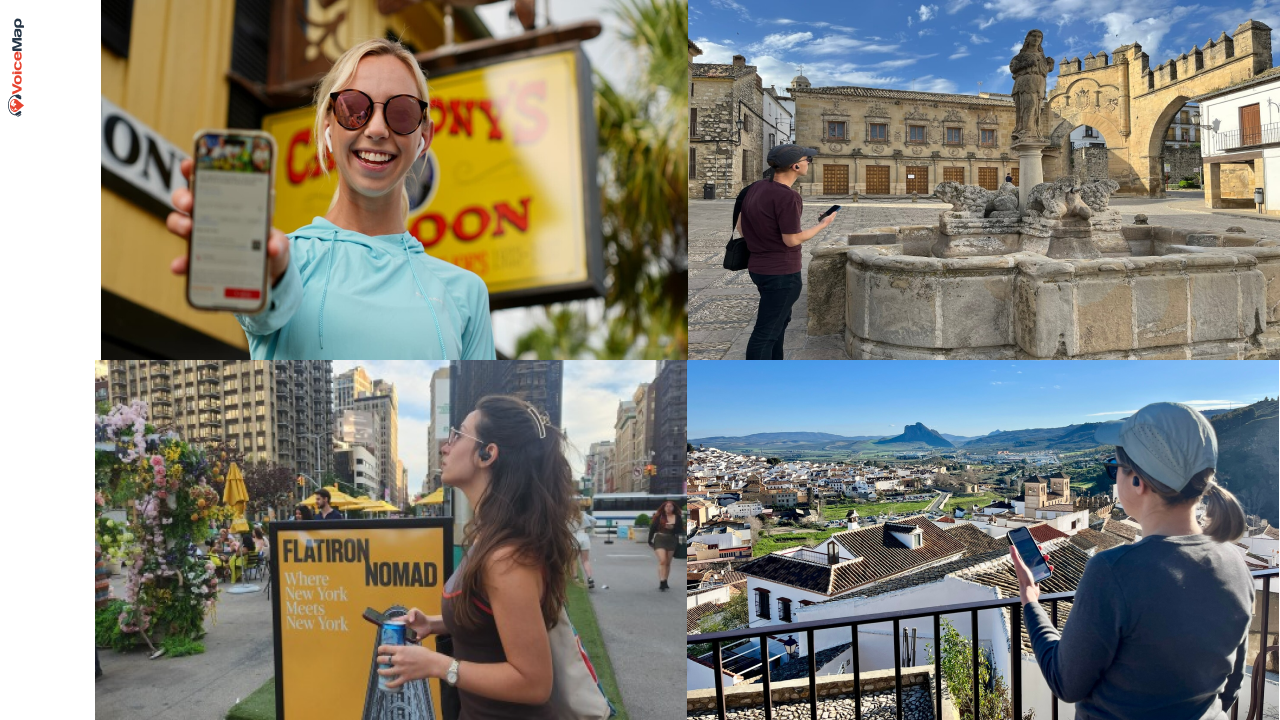
Testing your tour is also a good opportunity to take photos and videos for your social media and reseller listings – both of the locations themselves, and of people doing the tour. Candid shots of someone listening and exploring work particularly well. Here are some great examples from publishers.
3. Check your tour’s final touches
Your final touches are worth revisiting periodically, not just when publishing your tour. If your description was written a few years ago and no longer reflects the structured format we now use – built around what makes your tour special, what listeners will experience, and the practical details they need – get in touch with your editor and we can update it. A well-written description does real work for SEO and for conversions, and it’s worth getting right.
Check that you’ve selected categories for all your tours. Categories help listeners discover your tour when browsing in the app and on the web, and a tour without them is much harder to find. And make sure that the recommendations you make for places to stop for food or drink along the way are all up to date.
4. Fix any outdated content
Restaurants close. Attractions get renovated. Facts become dated. Go through your script with fresh eyes and flag anything that no longer holds. For small changes, like a closed restaurant, recording a short replacement clip and sending it to your editor is relatively straightforward. If your tour needs more significant updates, your editor can help by creating a clone of your existing tour so you can make changes without affecting the published version. Bear in mind that we need to unpublish your tour during this process, so significant updates are usually best tackled in the off season.
5. Check your recent reviews
We recommend looking at your listener reviews regularly, at least once a month. Reviews are often where listeners flag exactly the things you would want to fix, and responding to them promptly matters. A warm response to a positive review reinforces the connection a listener felt during the tour, and a thoughtful response to a critical review shows that you take the experience seriously. Future listeners read those responses just as closely as the reviews themselves. If your tour is on Viator and TripAdvisor, reach out to your editor and they can share a direct link to your tour’s listing, which is useful if you want to point your own network there and encourage more reviews.
Reviews also have a direct impact on how your tour performs on Viator and its partner channels. Tours with six to ten reviews are booked three times more on average than tours with only one to five. Tours with an average rating of 4.5 from 15 or more ratings receive a Badge of Excellence, which makes them considerably more attractive to potential buyers. Building reviews steadily is one of the most effective things you can do before peak season.
6. Update your publisher profile
Your publisher profile is more than a biography, it directly affects how your tours surface in search results. We’ve structured profiles around Google’s E-E-A-T framework, which weighs experience, expertise, authoritativeness, and trustworthiness, and a well-completed profile sends stronger signals to search engines and to potential listeners deciding whether to buy.
If you haven’t updated your profile recently, focus on four things: a strong bio, a tagline, updated social media links, and a couple of credentials. It takes around 15 minutes to work through the three sections, and the impact on discoverability is real. You can read more about how to do that here.
7. Quick updates via the distribution tab
Not everything requires a conversation with your editor. A few important updates can be made directly through the distribution tab in your publisher dashboard.
If your tour isn’t yet listed on Viator, this is where you can set that up. These listings are included on paid plans and are worth adding before the busy season picks up. You can find out more here.
Your featured location is also managed through the distribution tab. This is the stop a listener can access before they buy, so choose one with your most engaging audio and up to five compelling images. For a newly published tour, getting this right before your first push of promotion is one of the most effective things you can do. will appear more prominently on tour cards in the updated version of the app. Read more about how to set up your featured location here.
If there are any temporary disruptions on or near your route, such as construction, a closed attraction, or a seasonal access restriction, you can add a temporary notice to your tour page so listeners know what to expect before they set off. You can add a temporary notice at any time during the year. Read more about how to do that here.
8. Pricing for peak season
If you haven’t reviewed your price in a while, now is the right moment. You can update the tour price through your distribution tab. Price signals quality and lower price doesn’t necessarily mean more sales. In fact, it can just as easily mean fewer because some listeners associate a bargain price with a bargain experience. Unless your tour is very short, we’d recommend keeping your price at $9.99 or above.
Our data from the 1087 VoiceMap tours listed on Viator supports this: tours priced at $14.99 earn the most net revenue, with $11.99 close behind. Selling fewer tours at a higher price consistently outperforms selling more at a lower one. We’re also rolling out tour passes across more cities this year, where listeners can buy three, five, or ten tours at a discounted price, so it’s worth making sure your price reflects the value of what you’ve created before that picks up. Read more about how passes work here.
If you’re not sure where to start, walk your route first and go from there. Our next webinar is on 20 May, where Alicia Chamaillé, VoiceMap’s Head of Content Distribution, will cover promotion and distribution tools. You can RSVP here.
